What Glen Rock Homeowners Should Actually Know Before Hiring a Chimney Inspector
Glen Rock has a unique housing stock that many chimney companies don’t mention unless you ask.
A significant number of the borough’s homes were built between the 1920s and 1960s, which means many still have original clay tile liner systems that have endured decades of freeze-thaw cycles, coal-to-gas conversions, and, in many cases, deferred maintenance.
For these homes, an annual chimney inspection isn’t just routine maintenance. It’s the service that determines whether your fireplace is safe to use this winter. The question most homeowners get wrong isn’t whether to schedule an inspection. It’s how to choose the right person to perform it.
What You Can Honestly Handle Yourself
Before calling a professional, there are a few things most homeowners can safely inspect without specialized tools. A visual inspection of the firebox is a good place to start. Look for loose mortar joints between the visible bricks, white efflorescence staining on the masonry, and rust forming on the damper plate.
These are observations worth making before the inspection not problems you necessarily need a professional to discover. Cleaning the glass doors on a wood-burning insert is another task that’s safe to handle yourself.
Replacing a worn rope gasket on most insert doors is also manageable, provided you purchase the correct diameter gasket and use the recommended adhesive.
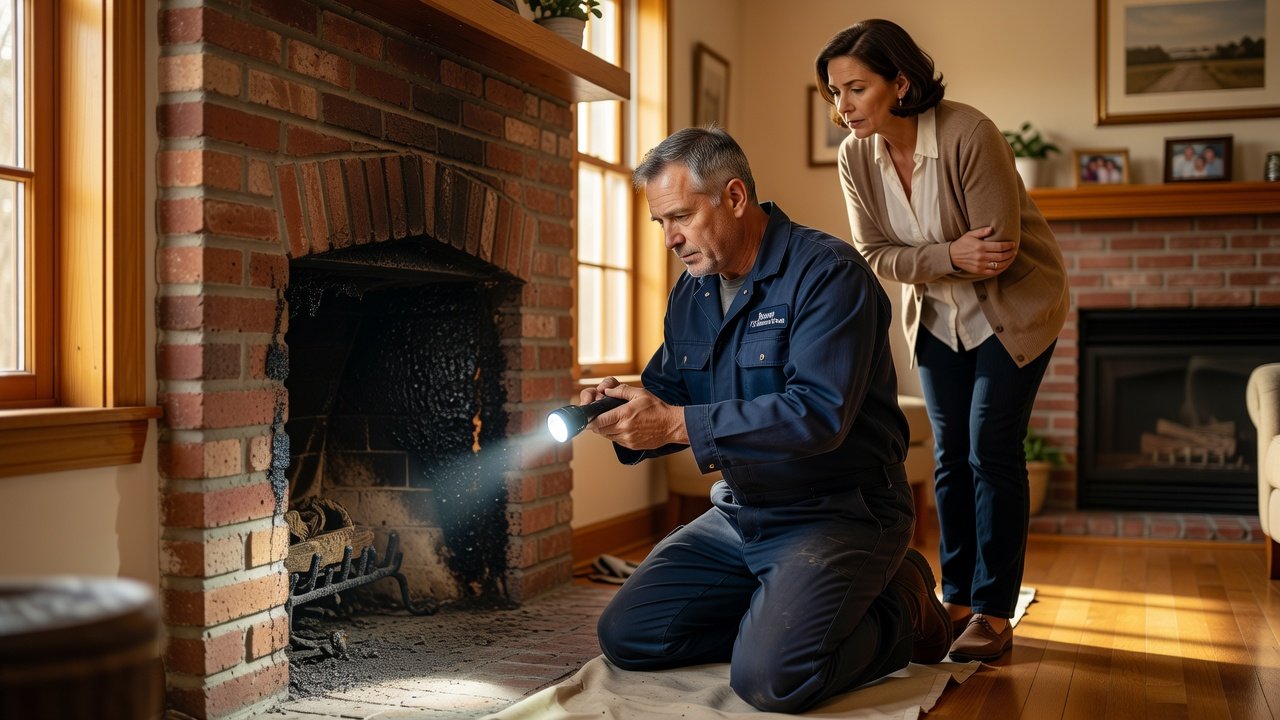
Checking whether the damper opens and closes completely is another simple inspection you can perform with a flashlight.
If you’re comfortable working on a ladder and your roof has a manageable pitch, you can also remove leaves or nesting material from around the chimney cap.
This is especially common in Glen Rock’s tree-lined neighborhoods near Maple Avenue and the side streets off Rock Road.
None of these tasks replaces a professional chimney inspection. However, making these observations beforehand allows you to provide useful information when the inspector arrives.
What Actually Requires a Qualified Professional
Here’s what should always be handled by a trained chimney professional and why.
Chimney Liner Inspection
A CSIA-certified chimney sweep uses specialized video equipment during a Level 2 chimney inspection to examine the interior of the flue.
A flashlight pointed up from the firebox cannot reveal cracked flue tiles, separated liner joints, or deteriorated mortar hidden inside the chimney.
According to NFPA 211, a Level 2 inspection is recommended whenever a property changes ownership or after any event that may have damaged the chimney.
Many Bergen County real estate transactions now require documented inspection reports.
Combustion Appliance Venting
If your fireplace shares a chimney with a gas furnace or water heater or if those appliances vent independently through the same chimney the venting system must meet specific code requirements.
Improper venting can allow carbon monoxide to enter your home.
This isn’t an area for guesswork.
Masonry Repairs Above the Roofline
Repairs such as tuckpointing, crown restoration, and chimney masonry work require the correct mortar mix, proper installation techniques, and safe roof access.
Improper repairs often allow additional water intrusion.
Given Glen Rock’s freeze-thaw climate, poorly executed masonry repairs can fail within a single winter.
Chimney Relining
Whether installing a stainless steel liner for a wood-burning appliance, a cast-in-place liner for an older masonry chimney, or a flexible liner for a gas insert, proper sizing and installation require technical expertise.
Qualified contractors understand appliance BTU requirements, vent sizing, and Bergen County permitting requirements.
The Real Risks of Hiring the Wrong Contractor
Creosote fires can exceed 2,000 degrees Fahrenheit.
According to the Chimney Safety Institute of America (CSIA), Stage 3 glazed creosote is one of the leading contributors to chimney fires.
A contractor who performs a chimney sweep without conducting a proper inspection or who inspects an older chimney without using a camera system may leave you with a clean-looking fireplace but hidden safety problems.
There’s also a building code concern.
Ridgewood and Glen Rock fall under the New Jersey Uniform Construction Code, which references NFPA 211.
Improper chimney liner installations or appliance venting performed by unqualified contractors can create code violations that surface during a future home sale and may complicate insurance claims following a fire.
Choosing the Right Inspector: Questions That Matter
When contacting a chimney company serving Glen Rock, ask these questions.
Ask for the company’s CSIA certification number.
Certification is different from simply belonging to a trade association.
It requires passing a comprehensive examination and completing continuing education.
Ask for proof of insurance.
Request current certificates showing both general liability and workers’ compensation coverage in New Jersey.
Ask what camera system they use for Level 2 inspections.
Professional chimney inspections rely on dedicated chimney camera systems with pan-and-tilt capabilities.
A consumer action camera attached to a pole isn’t an equivalent substitute.
Ask whether you’ll receive a written inspection report.
Any issue affecting the safe operation of your fireplace should be documented with photographs and written findings.
Ask how long they’ve worked in Bergen County.
Local experience matters.
Contractors’ familiar with Glen Rock, Ridgewood, Fair Lawn, and neighboring communities understand the construction methods and chimney systems commonly found in the area’s older homes.
Red Flags That Should Make You Walk Away
An unusually low price often means you’re paying for little more than a quick chimney sweeps rather than a thorough inspection.
In Bergen County, expect to pay approximately $150 to $250 for a Level 1 inspection and routine chimney sweeping.
A Level 2 inspection, including camera documentation and a written report, generally ranges from $250 to $450, depending on the chimney’s size and complexity.
If someone advertises a “$79 chimney inspection,” ask exactly what’s included.
Pressure to approve repairs immediately is another warning sign.
A reputable chimney inspector documents the findings, explains any safety concerns, and gives you time to consider your options or obtain a second opinion before committing to major repairs.
Finally, verify that the company has a legitimate New Jersey business presence.
A contractor with no physical address, only a mobile phone number, or a generic email account deserves additional scrutiny.
Schedule Your Chimney Inspection with Confidence
Ridgewood Chimney proudly serves homeowners throughout Glen Rock, Ridgewood, Paramus, Fair Lawn, Ho-Ho-Kus, and surrounding Bergen County communities.
If you’d like an honest assessment of your chimney before the heating season begins, contact us today to schedule your free chimney inspection consultation.
Our CSIA-certified technicians provide written inspection reports, camera documentation for every Level 2 inspection, and straightforward recommendations you can trust.
Call today or schedule your appointment online.
Our services
Reliable Chimney Care in Mission Viejo · Reliable Chimney Care in Los Alamitos · Reliable Chimney Care in Lake Forest · Reliable Chimney Care in Laguna Woods · Reliable Chimney Care in Laguna Niguel · Reliable Chimney Care in Laguna Hills
Areas we serve
Ridgewood, NJ · Ridgewood, NJ · Ridgewood, NJ · Ridgewood, NJ · Ridgewood, NJ · Ridgewood, NJ · All areas →