Chimney Cleaning in Allendale, NJ: What You Can Do Yourself and When to Call a Sweep
Most house fires don’t start from obvious neglect. They start from a slow buildup nobody thought to address: a quarter inch of creosote on the flue walls, a cracked tile liner nobody saw, or a bird nest wedged in just past the damper. In Allendale, where a lot of the housing stock dates to the 1950s through 1980s and wood-burning fireplaces are common, that quiet accumulation is exactly the kind of thing that can send families out of their homes in January.
This post is about being straight with you. Not every chimney task requires a truck in the driveway and a four-figure invoice. But some of them genuinely do, and pretending otherwise is how people get hurt.
What Allendale Homeowners Can Safely Handle
Capable homeowners can take on real chimney maintenance tasks without calling anyone. Here’s what falls in that category:
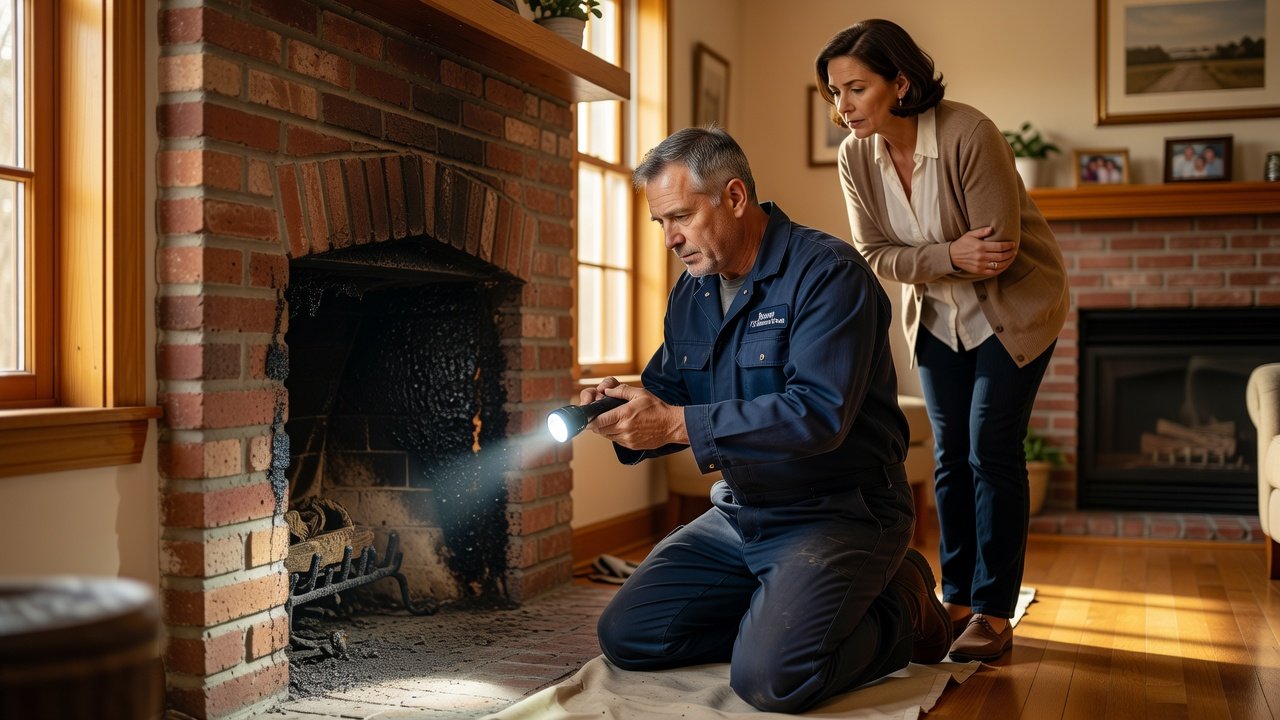
Firebox visual inspection. Grab a flashlight and look into the firebox, the brick chamber where you build the fire. Check for cracked or spalled bricks, white efflorescence, or mineral deposit staining, and deteriorating mortar joints between the bricks. You don’t need tools to do this. You need eyes and decent light. Document what you see with your phone camera.
Damper operation check. Open and close the damper a few times. It should move freely and seat fully when closed. If it sticks, rattles, or won’t seal, that’s information. Replacing a throat damper or cap-style damper is something an experienced DIYer can do if they’re comfortable on a roof, but know the scope before you climb up.
Cap and crown visual from the ground. Using binoculars from your yard, look at the chimney crown, the concrete cap that covers the top of the masonry, and the chimney cap, the metal or mesh cap over the flue opening. Missing, cracked, or rusted components are visible from ground level. You don’t need to climb to notice that something is wrong.
Cleaning the smoke shelf. The smoke shelf sits just behind the damper and collects debris, leaves, and rainwater. With the damper open, a homeowner with a shop vacuum and a flashlight can clear this area. Wear a dust mask and protect your eyes.
Exterior masonry assessment. Walk around the exterior of your home and look at the visible chimney above the roofline. Staining, efflorescence, gaps where the chimney meets the siding, and crumbling mortar are all things you can identify yourself before calling for repair quotes.
What Genuinely Requires a Professional Sweep
Some things look like minor tasks until they’re not. Here’s where the risk calculus changes.
Annual flue cleaning and inspection. NFPA 211, which governs chimneys and fireplaces, recommends that all chimneys be inspected at least once per year and cleaned as needed. The reason isn’t bureaucratic. It’s that the inside of a flue is dark, confined, and coated in a substance, creosote, that can ignite at around 1,100 degrees Fahrenheit.
A certified CSIA sweep uses rotary cleaning systems, professional-grade vacuums, and camera inspection equipment that reveals what no flashlight held through the damper can show. If you’re searching “chimney sweep near me Ridgewood” from Allendale, proximity matters. You want a local company with knowledge of Bergen County chimney construction, not a franchise dispatcher from another state.
Flue liner inspection and repair. Terra cotta liner tiles crack from thermal stress. A cracked liner allows combustion gases, including carbon monoxide, to migrate into your living space. This is not visible without a camera.
A Level 2 inspection, which CSIA defines as the standard for any change in the system or after a chimney event such as a flue fire, requires video scanning equipment. This is not DIY territory.
Creosote removal beyond Stage 1. First-stage creosote looks like loose soot and brushes off easily. Third-stage creosote is a hardened, tar-like glaze that bonds to liner tiles and requires chemical treatments or rotary stripping tools to remove.
If you open your damper and see a shiny black coating rather than gray ash deposits, call a professional. Using standard brushes on glazed creosote doesn’t remove it. It may just loosen pieces that fall and smolder.
Masonry repointing and crown repair. Allendale gets hard freeze-thaw cycles through December, January, and February. Water gets into hairline cracks, freezes, and widens them. Repointing mortar joints with the wrong mortar mix, a common DIY mistake, can actually trap moisture and accelerate spalling.
Chimney mortar is not the same as standard masonry mortar. A professional uses the correct refractory or Type S mortar rated for thermal movement.
Flashing repair. The metal flashing where the chimney meets the roof is one of the most common sources of water intrusion in Allendale homes. Improper flashing repair can void your roof warranty and create hidden rot in the roof deck.
Roofers and chimney professionals sometimes disagree on who owns this problem. Clarify the scope before any work begins.
The Real Cost of Getting It Wrong
A chimney fire in a residential property can cause tens of thousands of dollars in structural damage. More importantly, it can kill people.
The NFPA reports that heating equipment fires account for roughly 17 percent of U.S. home fires annually, with fireplaces, chimneys, and chimney connectors being a leading factor. In Bergen County specifically, homes in Allendale, Waldwick, Ho-Ho-Kus, and Ramsey share similar architectural periods and construction styles, meaning the failure patterns are predictable.
Older homes often have unlined chimneys or clay tile liners that haven’t been inspected in decades. If you bought a home in the last few years without a Level 2 inspection, you may not know what’s inside that flue.
A professional chimney sweep in the Allendale area typically charges $150 to $250 for a standard cleaning and inspection. A flue camera inspection adds to that cost but is worth considering if you’re buying, selling, or haven’t had the system evaluated in more than two years.
Liner repair or relining runs $1,500 to $5,000, depending on flue length and material. That’s significant, but it is a fraction of potential fire remediation costs.
Schedule Your Free Inspection
Ridgewood Chimney serves Allendale and the surrounding Bergen County communities, including Mahwah, Franklin Lakes, and Wyckoff.
If you haven’t had your chimney inspected this season, or if something you read above sounds familiar, call us or schedule online. The inspection is free, the technicians are CSIA-certified, and we’ll tell you exactly what your system needs, including if the answer is nothing right now.
Don’t wait for smoke to tell you something is wrong.
Related from Ridgewood Chimney: Chimney Sweep Cleaning Repair Ridgewood NJ in Glen Rock · Chimney Repair in Ridgewood, NJ — Know What to Look for Before You Cal
Our services
Chimney Repair in Ridgewood · Chimney Repair in Ridgewood, NJ · Stainless Steel Chimney Liners for Ridgewood, NJ Homes · Chimney Sweep Cleaning Repair Ridgewood NJ in Glen Rock · Chimney Cap Installation in Ridgewood, NJ · Reliable Chimney Care in Orange
Areas we serve
Ridgewood, NJ · Ridgewood, NJ · Ridgewood, NJ · Ridgewood, NJ · Paramus, NJ · Ridgewood, NJ · Ridgewood, NJ · All areas →